Hit N Blow

Crack a hidden four-bead code in eight tries. Every guess answers back in pins: red for a hit, white for a blow.
1–6 place a bead · ←→ move · ⌫ undo · Enter check · N new lock · M music
Rule card · from the box lid
How to play
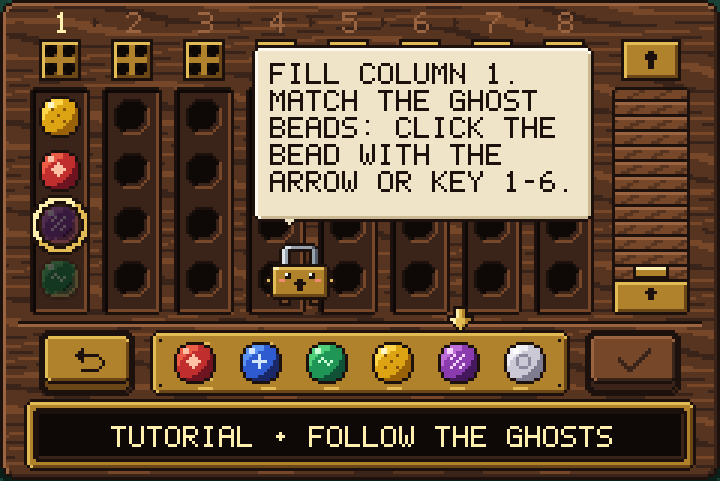
New here? Pip will walk you through it
The first time the page opens, the board starts in Tutorial mode. Pip plays a scripted three-column game with you: ghost beads show where to click, a brass arrow points at the next bead, and a speech bubble explains every pin as it drops. It takes about two minutes and ends on a real crack, tease included.
- Column 1 teaches blows and dud colors (0 hits, 2 blows).
- Column 2 teaches hits, and that pins never say which bead earned them (2 hits, 2 blows).
- Column 3 is the deduction: the two misplaced beads must trade holes. Then the drawer opens.
A code of four beads is locked in the roll-top drawer on the right. You get eight tries to name every bead and its hole.
- Fill the glowing column: click a bead on the brass rail, or press 1–6. Click a placed bead to take it back out.
- Press the red check button (or Enter). Pins drop into the plate above that column.
- Read the pins. Hit means a bead is the right color in the right hole. Blow means the color is in the code but in a different hole.
- Pins don't say which bead earned them. Compare columns, rule colors out, and crack it before column 8.
1 hit, 2 blows. Jade sits in the right hole. Cobalt and Cinnabar are in the code, just not where you put them. Saffron isn't in it at all.
With repeats on: 2 hits, 0 blows. Each bead in the code pays out once. Hits are counted first, so the lone Jade is already spent on hole 4 and the extra Jades earn nothing.
Solo
A fresh random lock every round. Repeats are off unless you flip the switch; with them off, the code uses four different colors and the rail greys out colors already in your row.
Daily lock
One code per calendar day, the same for everyone, repeats off. Your first run counts toward stats; afterwards it's practice. Copy your result as an emoji grid to share.
2 players
Pass the device. Players alternate columns on the same hidden code, reading each other's pins. First to 4 hits wins; eight columns with no winner is a stalemate.
Reference · Hit and Blow, 51 Worldwide Games (Switch)
From the clip to our board
We read the gameplay clip frame by frame for structure and feel, then rebuilt every piece from scratch in our own material world. Same rules, same rhythm, none of the original's art.
| What the clip shows | What Hit N Blow does |
|---|---|
| Eight numbered guess columns, four holes each, on a grey plastic board | Same 8 × 4 grid recessed into a walnut board; the active column's number lights up in brass shine |
| Six peg colors, each printed with a pattern (stripes, checks, swirls) | Six lacquer beads with a glyph each: diamond, cross, wave, five pips, stripes, ring. The game plays fine in grayscale |
| A 2 × 2 cluster of small pegs above each column: red = hit, white = blow | A brass key plate with four sockets; cinnabar and pearl pins drop in one at a time, each with its own chirp |
| The code hides inside a white drum on the right that rotates to reveal it | A walnut roll-top drawer under a brass keyhole badge. It rolls up when the game ends |
| Peg tray along the bottom, ring cursor on the active hole, banner lines like "Guess the color and order!" and "0 Hits! 2 Blows!" | A brass supply rail, a pulsing brass cursor ring, and an engraved plaque that carries every message in our own 5 × 7 font |
| "4 Hits!" then a "Clear!" medal | "CRACKED!" with a keyhole medal, and Pip the padlock popping its shackle |
Source: Hit and Blow – 51 Worldwide Games gameplay (YouTube, 10:04)Hit N Blow is a fan-made homage, not affiliated with Nintendo.
Art direction
A games-table heirloom
Walnut, brass and lacquer on green baize: the kind of code-breaking box that lives in a cupboard and comes out after dinner.
- Everything is drawn at 240 × 160, the Game Boy Advance's screen, and scaled up in whole pixels. No smoothing, no gradients.
- Light comes from the top left. Each material gets four shades, and the outline is walnut-black
#1c110c, never pure black. - Brass is for things you touch. Walnut is the board. Lacquer red is saved for the one primary action: check.
- Every bead color also has a shape, so no rule depends on telling red from green.
- Motion is mechanical: beads drop and settle, pins pop in one by one, the drawer rolls up. Nothing floats.
Walnut
Brass & steel
Baize
Lacquer beads · shine to shadow

Sound & feel · all synthesized live with Web Audio
One band, one beat
There are no audio files in the game. The music and every effect play live on one shared set of instruments: vibraphone, marimba, glockenspiel, electric piano, a plucked bass, rimshot, woodblock, shaker, bongos and a whistle. Effects also follow the music's clock and chords, so pins drop on the beat and harmonize with whatever chord is playing.
Music · "Clubhouse Shuffle"
112 BPM · light shuffle · F major · 16-bar A/B theme
- Fmaj7
- Dm7
- Gm7
- C7
- Am7
- D7
- Gm7
- C7
- B♭maj7
- B♭m6
- Am7
- D7
- Gm7
- C7
- Fmaj7
- Gm7 C7
Written in the spirit of Nintendo menu and puzzle music (think Mii Channel, Clubhouse Games or Animal Crossing): calm, but with a skip in its step. A composed, hummable vibraphone melody rides jazzy ii–V changes over a bouncy root–fifth bass. Electric-piano chords push ahead of the beat bossa-style, marimba taps the offbeats, and a soft kick, rimshot on 2 and 4, a swung shaker and bongo pickups keep it moving. The B section hands the tune to a whistle. Each pass changes the A melody: vibes first, then marimba doubled by glockenspiel, then a sparser chorus that lets the groove breathe. The music drops to a whisper during a tease and ducks under the clear jingle.
48-second offline render of the live engine, mixed to −26.5 LUFS (70% of the earlier soundtrack's level). Toggle in-game with the Music chip or M.
Placing a bead
- 0 msWoodblock "tok", the same woodblock the music uses for fills, plus a rimshot click and a soft kick for weight
- 0 msVibraphone note for that color, the same vibes that carry the melody
- 50 msSettle: a higher woodblock as the bead drops into the socket
- 75 msShaker tick. Pitch and level are nudged randomly each time
- +160 msFourth bead only: an electric-piano voicing of whatever chord the music is on, topped with glockenspiel
Each color is a step of the F-major pentatonic scale, the song's own key, so filling a row plays a little tune. Pins drop on the music's swung eighth notes: hit pins climb the current chord on glockenspiel, blow pins answer on marimba, so a scored row always fits the harmony underneath it. Pressing check plays a rimshot with that chord's root on bass. The drawer is a 12-click rimshot ratchet and a soft kick, then the code plays itself on vibes, in time.
Effects reel with the music off: four placements, a scored row, an undo, a near-miss tease and the drawer.
The near-miss tease
When a guess scores 3 hits, or on 60% of winning guesses, Pip stops the pins and makes a show of it. Because real wins get the same routine, a tease never gives the answer away. It runs on the first two 3-hit rows of every game, then half the time after that. Every beat below lands on a beat of the music, 0.54 s apart at 112 BPM. Click or press Enter to skip ahead.
- Beat 1"LET ME CHECK..."Pin 1 chimes. Pip peeks up from behind the plaque.
- Beat 2"OH?"Pin 2, with a rising whistle.
- Beat 3"OOH?"Pin 3, a higher whistle. Pip gasps.
- Beat 4"IS THIS IT...?"Bongo roll and a shaker swell. The music drops to a whisper, the board dims to a spotlight on your column, and the drawer rattles.
- Beat 6"IS THIS REALLY IT...?"The fourth pin socket blinks and the column's beads jitter.
- Beat 8"YES!! IT IS!!" or "NAH. J/K!"Either the band's own "ta-da" (electric piano, a glockenspiel run and a kick) or a woodblock bonk and a whistled "wah-wah-wah-waaah" while the board shakes and Pip laughs.
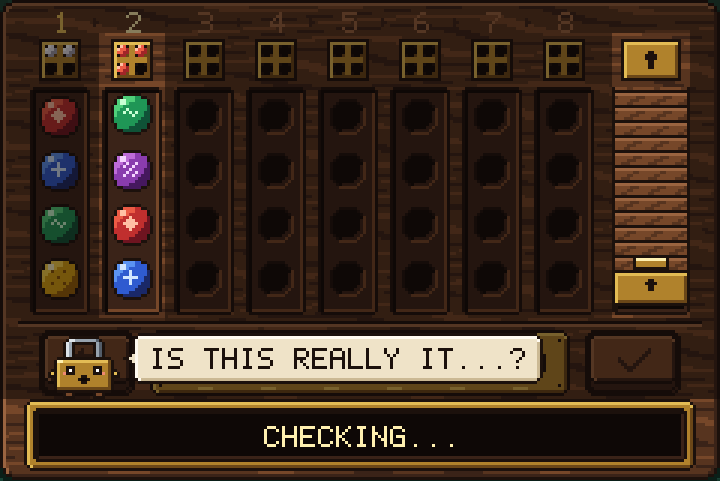
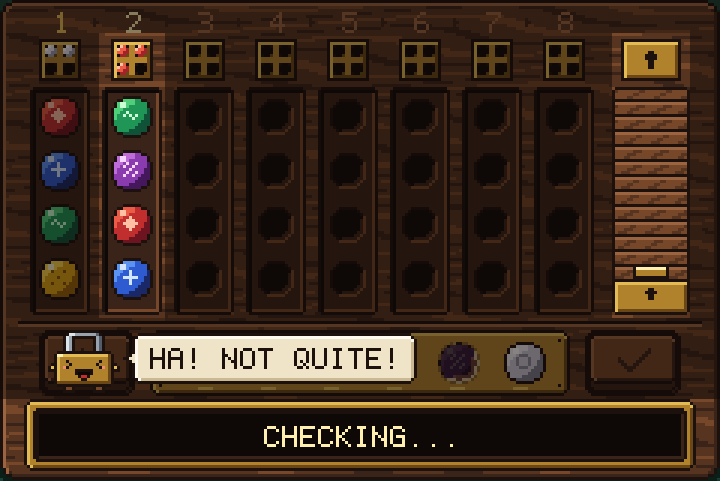
A teased win with the music off: pins, bongo roll, ta-da, the drawer, the code on vibes, then the clear jingle (a vibes run into an F major 9 chord with glockenspiel).
Parts tray · drawn in Aseprite 1.3.17
Every asset in the box
All fourteen sprites come from one Aseprite script, art/draw_assets.lua. It paints them pixel by pixel from hand-typed maps, saves layered .aseprite sources with named frames and tags, and exports the PNG strips the game loads.
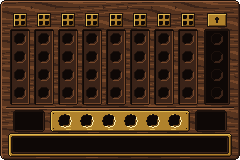


Screenshots · captured from this build
On the table
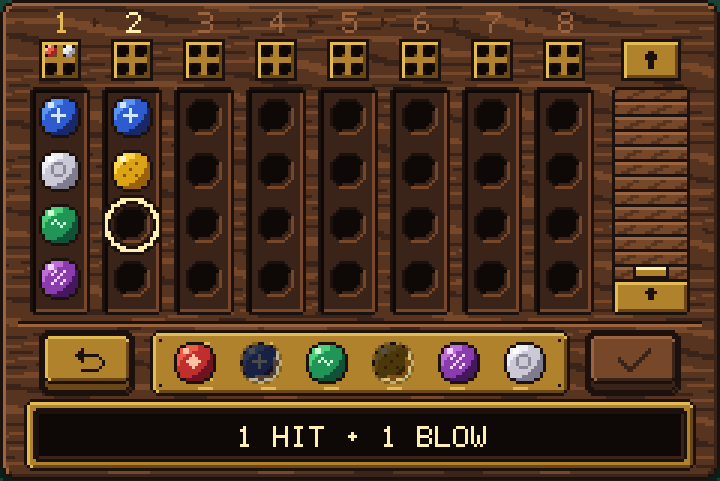
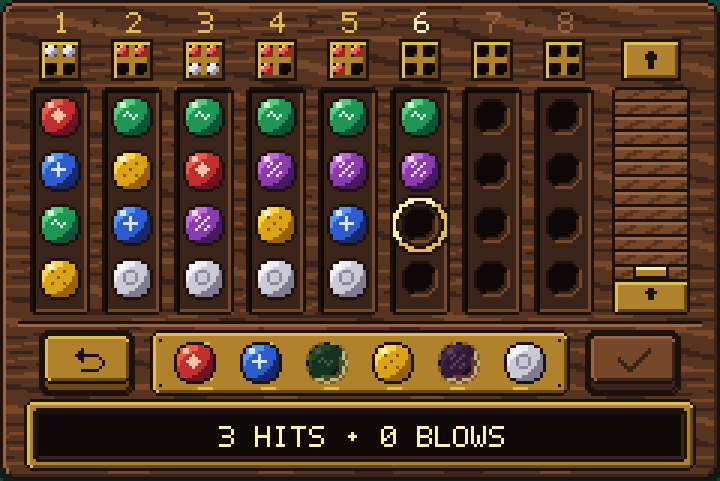
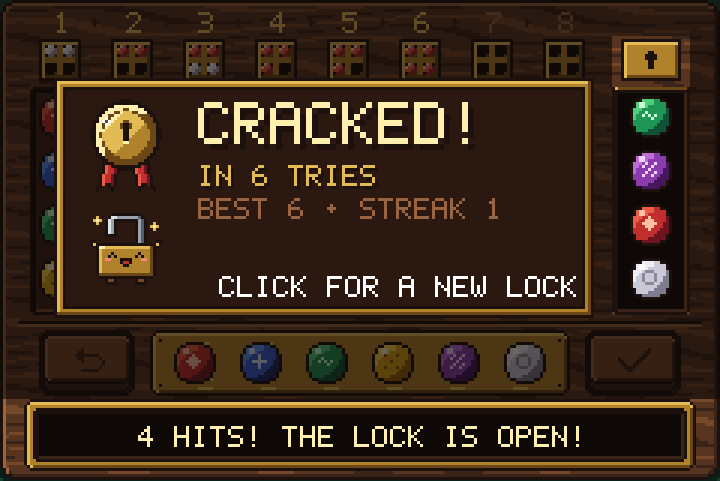
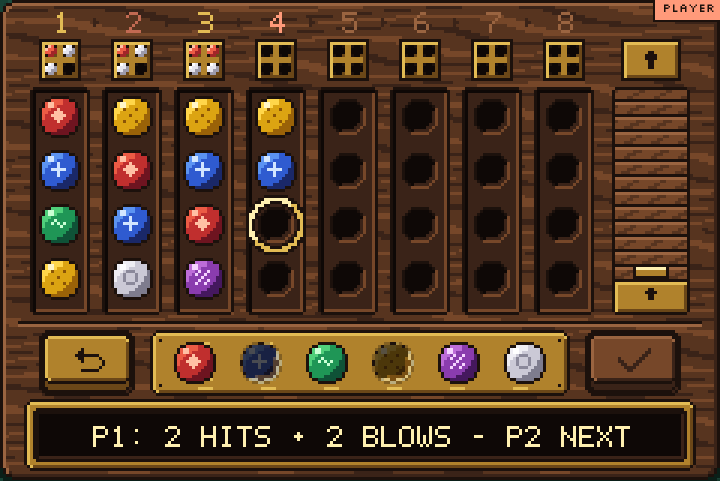
What's in this build
Features
Guided tutorial
Sixteen scripted steps over three columns, with ghost beads, a pointer and Pip explaining each pin.
Three play modes
Solo, a date-seeded Daily lock with a copyable result grid, and hot-seat 2-player.
The tease
A near-miss or a win can trigger Pip's drumroll routine. Wins and misses look the same until the last beat.
Repeats switch
Off: four distinct colors, used colors grey out. On: 1,296 possible codes and trickier pin math.
Mouse, touch, keys
1–6, arrows, ⌫, Enter, N, M. Tap a placed bead to clear it.
Readable by anyone
Glyph on every bead, and a screen-reader line for each placement, result and reveal.
Stats that stick
Played, crack rate, streak and best, stored in this browser only.
Nintendo-style soundtrack
A composed 16-bar light-jazz theme at 112 BPM: vibes and marimba over a bouncy bass, calm but upbeat. Music and effects toggle separately.
One sound world
Every effect uses the band's instruments, lands on its beat and follows its chords. Woodblock bead drops, glockenspiel hits, marimba blows.
~/Desktop/work/games/hit-n-blow/
  art/draw_assets.lua        Aseprite script that draws every sprite
  art/src/*.aseprite         14 layered sources, frames and tags intact
  art/hitnblow-palette.gpl   the 49-color palette
  assets/*.png               exported strips the game loads
  src/game.js                engine: rules, input, rendering, tease, tutorial
  src/audio.js               music + sound effects, all Web Audio synthesis
  audio-preview/*.wav        offline renders of the music and effects
  dist/play.html             the game on its own page